
When changing a lock or moving into a new home, we rarely examine our key closely. It opens, it closes, it does the job. ISEO keys deserve a bit more attention because their design directly influences the level of protection for your door.
ISEO Key and Property Card: the Anti-Copy Mechanism
Have you ever tried to have a key duplicated at a local cobbler-locksmith? With a standard flat key, the operation takes two minutes. With a protected range ISEO key, the refusal is almost systematic.
The principle is based on a patented design that limits reproduction to authorized circuits. Specifically, each high-security ISEO cylinder comes with a property card. This card serves as proof: without it, no authorized locksmith will agree to cut a duplicate.
The duration of this protection depends on the industrial property title associated with the model. The INPI specifies that a patent protects an invention for a maximum duration of twenty years from the filing date, subject to maintenance in force. Once the patent expires, reproduction becomes free again. It is therefore relevant to check whether the cylinder model installed in your home still has active protection, as detailed on the Serrurerie Valbusa website in its dedicated technical sheet.
This card system is not just administrative. It creates a traceability of each duplicate issued. You know how many keys are in circulation, and no one can create one behind your back.
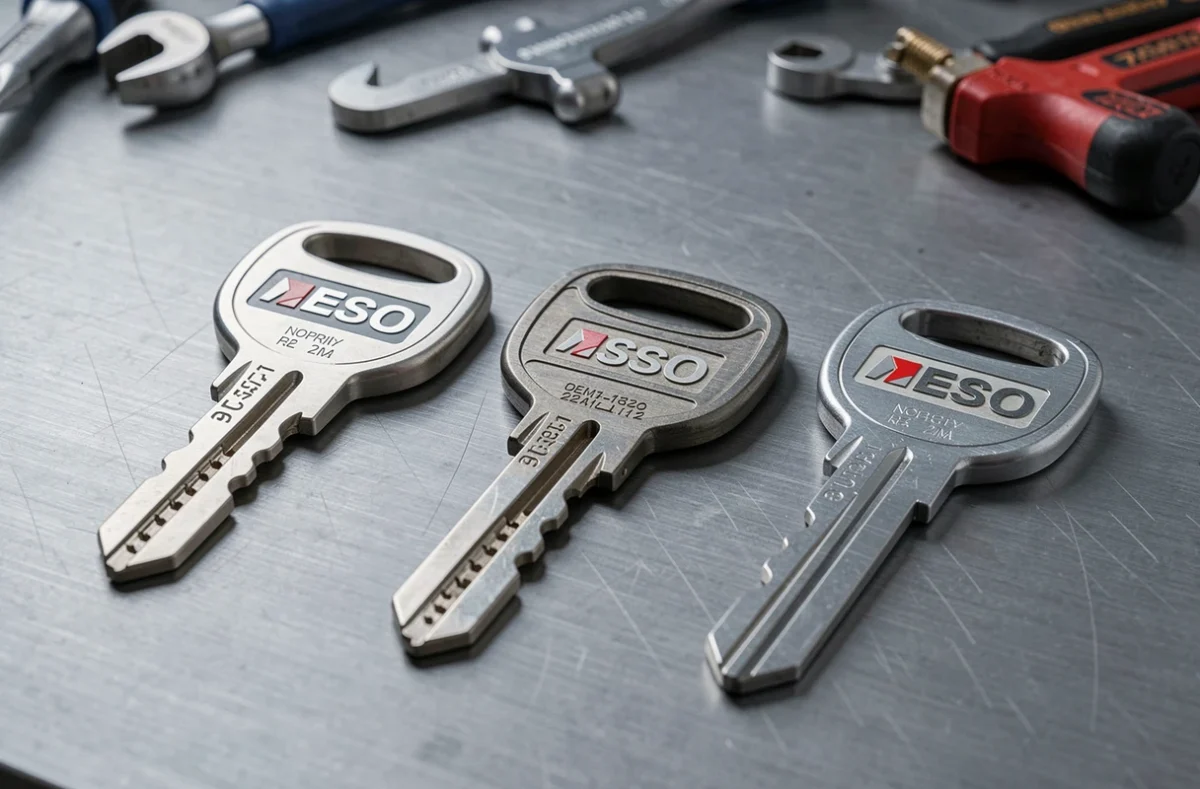
ISEO Key Profile: Understanding the Differences Between Models
ISEO does not manufacture just one type of key. The catalog includes several profiles, each associated with a cylinder and a distinct level of security. Two examples illustrate the difference.
F9 Key: the Common Mechanical Profile
The F9 key is a flat pin profile, common on entry-level ISEO cylinders. It offers broad compatibility and a moderate reproduction cost. Its geometry remains relatively simple, making it suitable for interior doors or premises with moderate risk.
F9000 Key: RFID Transponder and Electronic Management
The F9000 represents a technological leap. In addition to the mechanical profile, it incorporates a RFID transponder that allows for electronic access rights management. Each key can be activated, deactivated, or reprogrammed without changing the cylinder.
For an office building or a condominium, this function is a game changer. A tenant leaves? Their rights are revoked remotely, without changing the lock. The initial cost is higher, but savings on managing duplicates quickly compensate.
ISEO Cylinder and EN 1303 Standard: What the Certification Really Covers
Many product sheets mention the European standard EN 1303 as a guarantee of security. The reality is more nuanced.
The EN 1303 standard evaluates the cylinder alone, not the entire door. It tests the resistance to drilling, pulling, and picking of the cylinder. An ISEO cylinder certified according to this standard has demonstrated its strength against these three mechanical attacks.
However, if your door is made of softwood, if the lock is a simple single-point, or if the protective trim is absent, the cylinder may be excellent without the installation being secure. Here are the elements to check to ensure the ISEO cylinder fulfills its role:
- The multipoint lock (three or five locking points) distributes the stress along the entire height of the door, not just at the handle level.
- The rose or protective escutcheon prevents direct access to the cylinder from the outside, blocking attempts to pull it out with pliers.
- The frame and the door leaf must be sufficiently rigid to avoid deformation under a kick or crowbar.
An ISEO high-end cylinder on a fragile door is like a safe with the wall around it left unclosed.

Management of ISEO Keys in Condominiums or Businesses
The security of a building does not solely depend on the quality of the cylinder. It also relies on how keys circulate on a daily basis.
ISEO offers key hierarchies (or locking plans) that prioritize access. The principle: a “master key” opens all doors, while individual keys only open the accesses assigned to their holder.
This system avoids the anarchic multiplication of duplicates. In a residence with several dozen units, each occupant has their personal key for their apartment and common areas, without being able to access other units or technical rooms.
With the electronic range (F9000 and connected systems), this management becomes modifiable without physical intervention. Rights are added or removed via software, which reduces the response time in case of loss or theft to a few minutes instead of several days.
Durability of ISEO Keys: Wear and Replacement
A key used several times a day eventually wears out. The profile rounds off, insertion into the cylinder becomes less smooth, and the mechanism may jam.
The surface treatment of ISEO keys limits oxidation and maintains the precision of the profile longer than an untreated raw key.
Two signals should alert you:
- The key turns with difficulty or requires a “jiggling” motion to operate the cylinder.
- Visible burrs or deformations appear on the notches or grooves of the key.
- The cylinder squeaks or resists when it previously functioned normally.
In these cases, replacing the worn key before it damages the cylinder costs much less than changing the entire system.
Choosing an ISEO key engages a complete ecosystem: cylinder, property card, certification level, and access management mode. Checking the consistency between these elements and the quality of your door remains the most cost-effective action for your security.