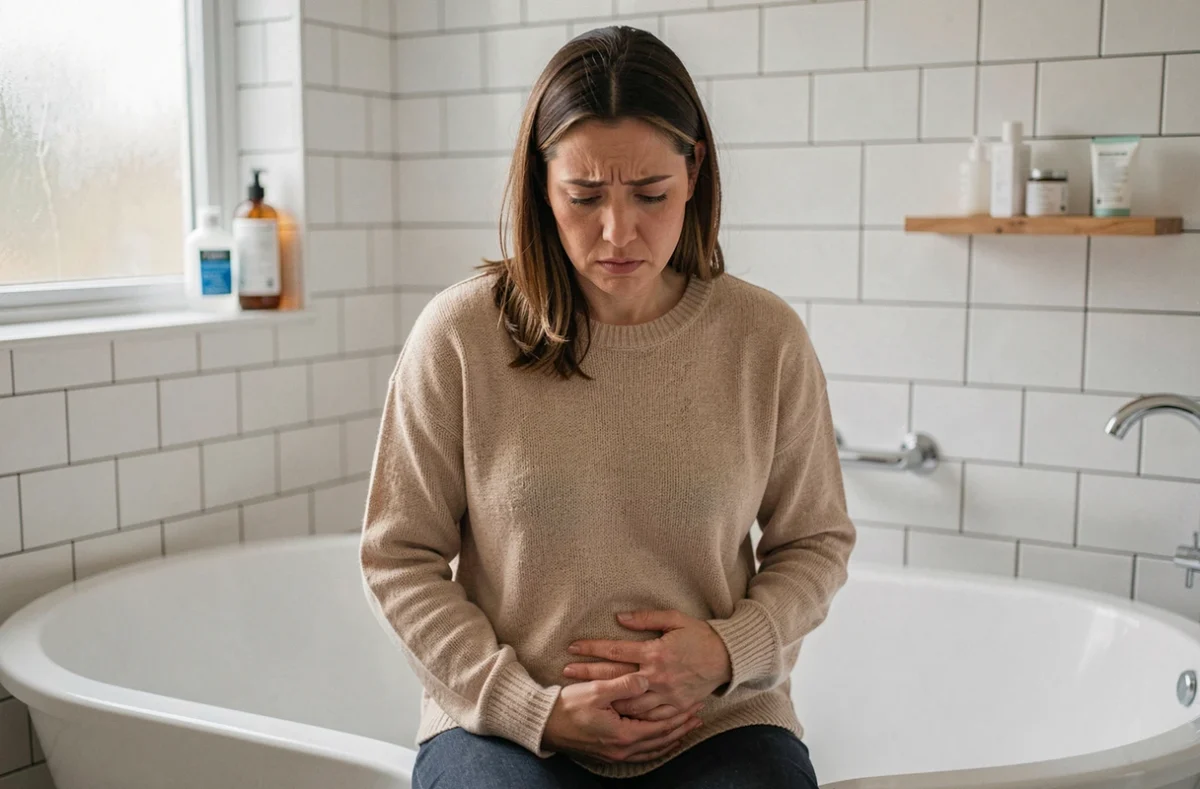
The color of stools directly reflects the functioning of the liver, gallbladder, and bile ducts. When white or very pale stools occur alongside abdominal pain, the question of the alert threshold arises. Two parameters help to sort the situations: the duration of the color change and the accompanying signs.
Bile and stool coloration: the malfunctioning mechanism
Bilirubin, derived from the breakdown of red blood cells, is captured by the liver and then excreted in bile. Once in the intestine, the microbiota transforms this bilirubin into stercobilin, the pigment responsible for the usual brown color of stools.
Any interruption of this circuit produces discolored stools. The problem can occur at three levels: insufficient bile production by the liver, mechanical obstruction of the bile ducts, or alteration of the intestinal microbiota that no longer properly transforms bilirubin.
To understand white stools, it is essential to first identify which of these three levels is affected, as the severity and management differ radically from one case to another.
Causes of white stools with abdominal pain: comparative table
The most common causes do not all present the same degree of urgency. The following table classifies situations according to the type of associated pain and accompanying signs.
| Cause | Location of pain | Associated signs | Urgency |
|---|---|---|---|
| Biliary stone (choledocholithiasis) | Upper right abdomen, radiating to the shoulder | Dark urine, jaundice, nausea | Quick consultation |
| Viral hepatitis | Diffuse or under the right ribs | Fatigue, mild fever, jaundice | Quick consultation |
| Bile duct infection (cholangitis) | Upper right abdomen | Fever, chills, jaundice | Emergency |
| Bile duct tumor | Dull or absent pain | Weight loss, progressive jaundice | Consultation without delay |
| Medication or dietary supplement | Variable or absent | Onset after introduction of treatment | Scheduled consultation |
The gap between these situations is clear. A biliary stone lodged in the common bile duct generally causes intense and sudden pain under the right ribs, accompanied by dark urine. Viral hepatitis develops more gradually, with marked fatigue over several days.
Cholangitis is characterized by the triad of fever, chills, and jaundice. An infected bile obstruction can progress to a generalized infection, making it the most urgent scenario in the table.
Alert symptoms: what separates benign from urgent
Isolated pale stools, occurring once after a very fatty meal or the intake of an antacid, do not justify rushing to the emergency room. The situation changes when several signs converge.
The combinations that require a quick consultation:
- White stools persisting beyond two or three days, associated with abnormally dark urine (tea or cola color)
- Visible yellowing of the skin or the whites of the eyes, even slight, accompanied by abdominal pain
- Fever above 38 °C with pain in the upper right quadrant of the abdomen and discolored stools
- Unintentional weight loss over several weeks, with greasy or pale stools
The simultaneous presence of fever, pain, and jaundice constitutes a reason for urgent evaluation. One should not wait for all three signs to be present to consult: two out of three are sufficient to justify a medical opinion on the same day.
Special case of the infant
In an infant or young child, very pale or clay-colored stools should be reported quickly to the pediatrician. Biliary atresia requires early diagnosis to avoid irreversible liver damage. Health records sometimes include a colorimetric scale for stools to detect this type of anomaly in the first weeks of life.
Diagnosis of discolored stools: what tests does the doctor prescribe
The clinical evaluation does not rely solely on the color of the stools. The doctor first reconstructs a precise history: date of onset, recently introduced medications or supplements, alcohol consumption, recent travel.
A recently started medication or supplement is information that should always be reported. Some hepatotoxic treatments can alter bile production without causing immediate pain. A pale stool that appears after the introduction of a product does not suffice to establish a cause-and-effect link, but it guides the assessment.
First-line biological tests include:
- A liver function test (transaminases, gamma-GT, alkaline phosphatases) to assess liver function
- A total and conjugated bilirubin measurement to quantify obstruction
- Sometimes a measurement of pancreatic enzymes if pancreatic involvement is suspected
Abdominal ultrasound is the first-line imaging examination. It allows visualization of the gallbladder, bile ducts, and liver. Depending on the results, a CT scan, a biliary MRI, or an endoscopic procedure may complete the exploration.
Benign situations versus biliary pathologies: the differences that matter
The distinction relies on duration and associated signs. A transient discoloration (a few hours, a day) without any other symptoms most often corresponds to a one-time dietary or medication factor. Transit returns to its normal color as soon as the factor disappears.
In contrast, white stools that persist for several days indicate a disruption of bile flow that goes beyond simple digestive slowing. The association with dark urine reinforces this hypothesis, as bilirubin not excreted in the intestine is then eliminated by the kidneys, darkening the urine.
The most discriminating criterion remains jaundice. Visible jaundice, even slight, indicates a bilirubin level high enough for the pigment to accumulate in the skin. At this stage, a mechanical or hepatic cause is very likely, and medical assessment becomes a priority.
The color of the stools is just one indicator among others, but its diagnostic value increases significantly when accompanied by localized pain, fever, or urinary changes. Reporting these associations to a doctor, even by phone, allows for quick sorting between simple monitoring and further exploration.