
The Black+Decker CD601 is a corded circular saw with a power of 1100 W, designed for cutting wood in a home setting. This model is no longer listed in the current European catalog of Black+Decker, classifying it among the so-called “legacy” machines, primarily available on the second-hand market or as leftover stock.
Its positioning remains relevant for common DIY tasks. The motor power, blade diameter, and cutting depth meet the needs of non-professional use, provided that one understands what this machine can and cannot do.
Motor Power and Cutting Depth of the CD601
The 1100 W motor places the CD601 in the entry-level category of circular saws for home use. This power is sufficient to cut through solid wood panels, plywood, MDF, or flooring boards without straining the motor.
The cutting depth is the technical criterion that determines the maximum thickness of material that the blade can cut through in a single pass. On the CD601, this capability allows for working with commonly thick pieces in interior design.
For straight cuts in soft to medium-hard wood, the Black & Decker CD601 circular saw remains a suitable tool. Very dense woods or thick plywood panels require more power and higher torque.
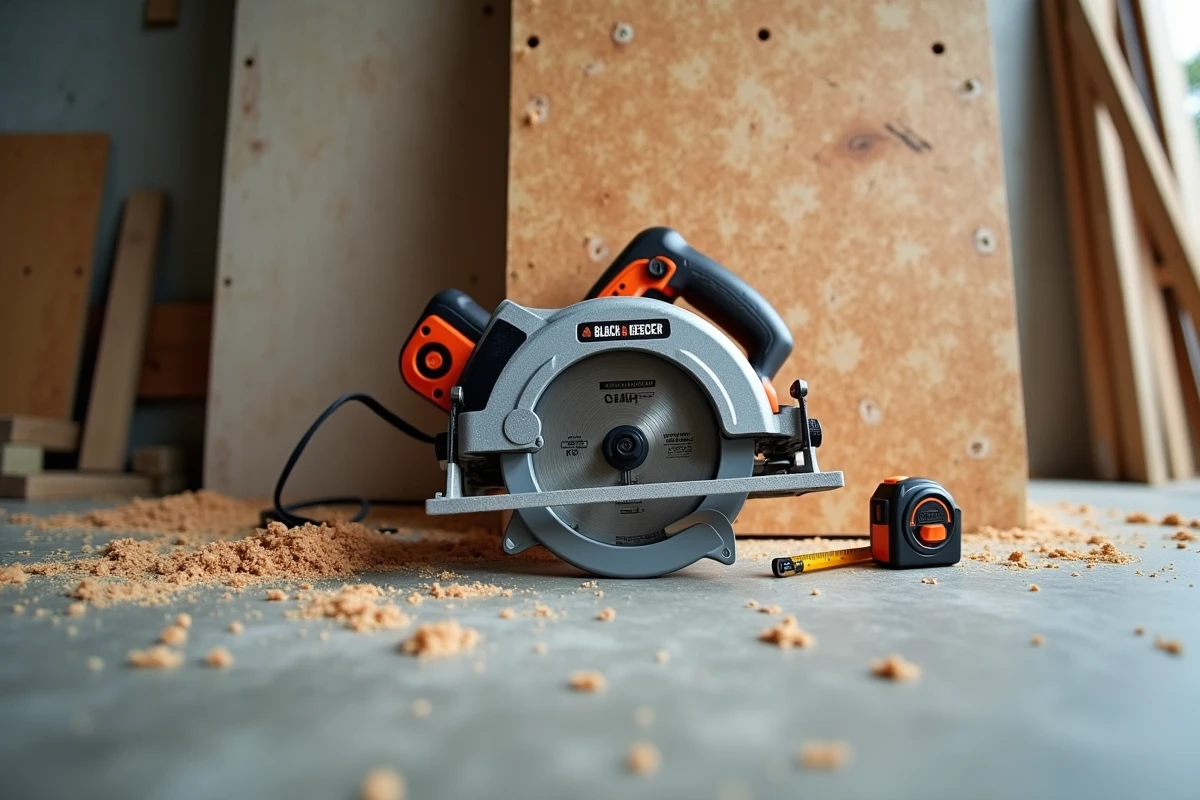
Circular Blade and Cutting Quality on Wood
The quality of a cut depends as much on the blade as on the motor. The CD601 uses a standard-sized blade, making it easy to replace with models from third-party brands.
The choice of blade directly affects the precision of the cut line. A fine-toothed blade produces clean cuts on melamine or plywood. A blade with more widely spaced teeth is suitable for quick cutting of raw wood, at the cost of a less clean surface finish.
- A carbide-tipped blade offers a longer lifespan than a standard steel blade, especially on abrasive panels like MDF
- The diameter of the blade determines the maximum cutting depth; check compatibility before purchasing a replacement blade
- The number of teeth influences the trade-off between cutting speed and finish: more teeth for precision, fewer for speed
In this regard, the CD601 does not stand out from other circular saws in its range. Its advantage lies in the availability of compatible blades at moderate prices, a benefit for DIY enthusiasts who alternate between different types of wood.
Technical Limitations Compared to Recent Circular Saws
Circular saws released after 2020 incorporate features that the CD601 does not offer. The absence of a quick motor brake is the most notable: on recent models, the blade stops within seconds after releasing the trigger, reducing the risk of accidents during handling.
Dust extraction is another weak point. Current models, including those in the Black+Decker range, have extraction systems compatible with workshop vacuums. On the CD601, chip management remains rudimentary.
Ergonomics and Noise Level
User feedback from those who have kept their CD601 for several years mentions a high noise level compared to current standards. The improved double handles found on recent Bosch or Makita models provide better lateral control during cutting.
These discrepancies do not render the CD601 obsolete for occasional use. They indicate that user comfort has improved in this price range, and that the CD601 is more suited to occasional use than to regular job sites.

Buying a Used CD601: Points to Check
Since this model is no longer distributed new by major retailers, purchasing often goes through the second-hand market. Several elements deserve inspection before finalizing a transaction.
- Check the condition of the power cord and trigger: a frayed cord or a sticky trigger indicates advanced wear
- Inspect the sole plate’s play relative to the housing: excessive play degrades cutting precision and may indicate past impact
- Request a no-load test to listen for motor noise; a squeak or abnormal vibration reveals worn bearings
- Check the availability of the parallel guide, often lost on second-hand machines
A well-inspected used model remains functional for occasional work. Users who have owned their CD601 for over five years confirm the durability of the motor on spaced domestic projects.
CD601 Compared to Entry-Level Bosch and Makita Circular Saws
In the same price range (new, before its removal from the catalog), the CD601 compared to the entry-level Bosch PKS and Makita HS models. These two brands now offer circular saws with motor brakes, integrated dust extraction, and more precise bevel adjustments.
The CD601 retains an advantage in one area: its mechanical simplicity. Less embedded electronics means fewer components that are likely to fail. For a DIYer looking for a robust machine without superfluous features, this approach makes sense.
The choice between these brands depends on usage frequency. For occasional cuts on construction wood or interior design, the CD601 meets needs without additional investment. For regular work requiring precision and comfort, the current ranges from Bosch and Makita justify their price.
The CD601 remains a reliable machine whose longevity is confirmed by long-term users. Its main flaw is not a matter of raw performance, but of comfort and passive safety, two areas where standards and expectations have changed since its design.